

Sempre que o assunto é tela, a conversa costuma seguir o mesmo caminho. Falamos sobre as crianças que não querem mais brincar ao ar livre, que preferem videogames a bicicletas, que passam horas no YouTube e que parecem cada vez menos interessadas em interações reais. Mas existe uma parte dessa conversa que quase ninguém quer ter: o vício dos adultos.
Eu não cresci com telas. As pessoas da minha geração e das gerações anteriores também não. Nós passávamos horas na rua, conversávamos ao telefone fixo quando ele estava disponível, encontrávamos amigos sem precisar compartilhar localização em tempo real e, principalmente, aprendíamos a estar presentes. Talvez por isso seja tão estranho observar o que está acontecendo hoje.
Outro dia, sentei na frente de casa para tomar um vinho com uma vizinha. A ideia era conversar, colocar o papo em dia, aproveitar o fim da tarde. Ela apareceu com um iPad para jogar enquanto conversávamos. Conversávamos? Na verdade, ela estava ali fisicamente. Mentalmente, estava em outro lugar. E ela não é a única. Tenho familiares com quem converso mais quando estou em Nova York do que quando vou ao Brasil. Parece absurdo, mas é verdade. Quando estou longe, trocamos mensagens, fazemos chamadas de vídeo e compartilhamos momentos. Quando estou presente, sentada ao lado deles, muitas vezes o celular se torna o protagonista da cena. Eles estão comigo, mas não estão realmente comigo. É como se o aparelho exercesse uma força impossível de ignorar. Uma necessidade constante de verificar notificações, assistir mais um vídeo, responder mais uma mensagem ou simplesmente rolar a tela sem propósito.
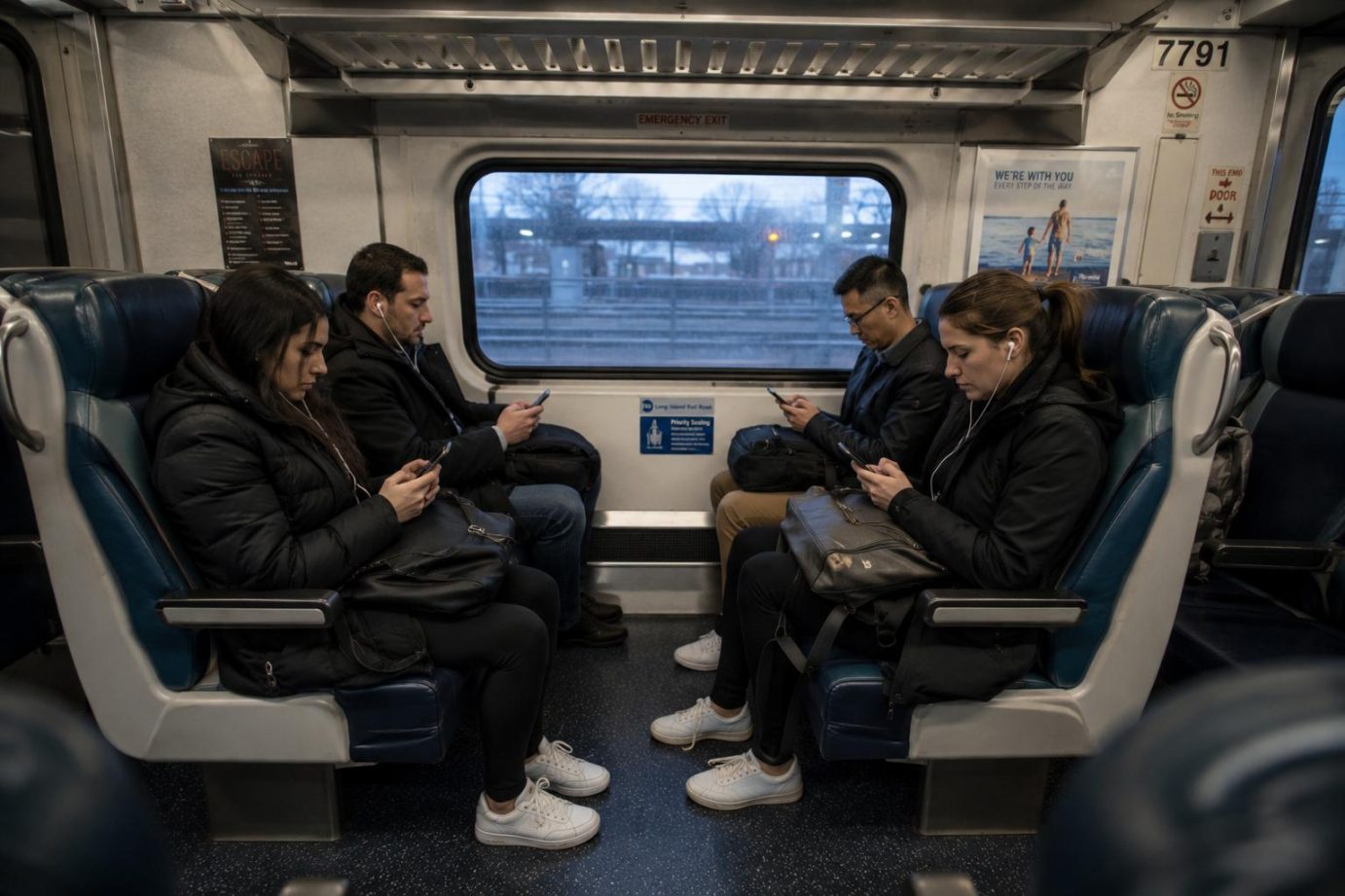
Hoje de manhã, indo para o trabalho, percebi isso de forma ainda mais clara. Normalmente estou lendo um livro durante o trajeto e acabo prestando pouca atenção ao redor. Mas hoje resolvi ouvir um podcast recomendado por uma amiga. Levantei os olhos e comecei a observar as pessoas no trem. Quase todas estavam olhando para baixo. Algumas com o pescoço tão curvado que parecia desconfortável. Outras completamente absorvidas pelas telas. O que mais me chamou a atenção não foi a postura física, embora ela também seja preocupante. Foi o silêncio. Ninguém conversava. Ninguém trocava olhares. Ninguém sorria para um desconhecido. Ninguém paquerava.
No metrô, talvez isso fosse mais esperado. As pessoas costumam sentar mais afastadas, cada uma em seu espaço. Mas no trem é diferente. Muitas vezes estamos sentados de frente uns para os outros. A poucos centímetros de distância. Mesmo assim, é como se todos estivessem sozinhos. Cada pessoa dentro da sua própria bolha digital. E às vezes eu me pergunto como chegamos tão rápido a esse ponto. Há poucos anos, durante a pandemia, o que mais desejávamos era justamente aquilo que nos foi tirado: abraçar amigos e familiares, sentar à mesa juntos, conversar cara a cara, compartilhar momentos sem medo. Ninguém sonhava com um iPhone mais novo ou passava o dia pensando no que estava acontecendo nas redes sociais. O que faltava era contato humano. Talvez por isso seja tão surpreendente perceber como, depois de recuperar essa liberdade, tantos de nós voltamos a trocar a presença real pela companhia constante de uma tela.
E aqui está a grande ironia: nunca estivemos tão conectados e, ao mesmo tempo, tão desconectados. Passamos horas acompanhando a vida de pessoas que nem conhecemos enquanto ignoramos quem está sentado ao nosso lado. Sabemos o que um influenciador comeu no café da manhã, mas não perguntamos como foi o dia de alguém da nossa própria família. Talvez seja por isso que eu tenha dificuldade quando ouço que apenas as crianças precisam reduzir o tempo de tela.
As crianças observam muito mais do que escutam. Se queremos que elas larguem os celulares para brincar lá fora, precisamos primeiro olhar para os nossos próprios hábitos. Porque é difícil convencer uma criança a viver o mundo real quando os adultos ao redor parecem preferir viver dentro de uma tela.
Talvez o desafio não seja apenas educar nossos filhos sobre tecnologia. Talvez seja reaprender a estar presentes. Olhar nos olhos. Ouvir sem distrações. Conversar sem interromper a conversa para verificar uma notificação. E lembrar que as melhores conexões ainda não dependem de Wi-Fi. Elas dependem de atenção. Às vezes penso que, daqui a alguns anos, talvez existam clínicas especializadas em reabilitação para dependentes de telas da mesma forma que hoje existem para alcoólatras e dependentes químicos. Espero estar errada. Mas quando observo pessoas incapazes de passar alguns minutos sem verificar o celular, começo a acreditar que esse futuro talvez não esteja tão distante quanto imaginamos.
(English)
Cell phone addiction isn’t just a children’s problem
Whenever the topic of screen time comes up, the conversation usually follows the same path. We talk about children who no longer want to play outside, who choose video games over bicycles, who spend hours on YouTube, and who seem increasingly uninterested in real-life interactions. But there’s one part of this conversation that almost nobody wants to have: adult screen addiction.
I didn’t grow up with screens. Neither did people from my generation or the generations before me. We spent hours outside, talked on landline phones when they were available, met friends without sharing our location in real time, and most importantly, learned how to be present. Maybe that’s why it’s so unsettling to watch what’s happening today.
The other day, I sat outside my house with a neighbor to enjoy a glass of wine and catch up. The idea was simple: talk, relax, and enjoy the evening. She showed up with her iPad and spent the time playing a game. Were we really catching up? Physically, she was there. Mentally, she was somewhere else. And she’s not the only one. I have family members I probably talk to more when I’m in New York than when I visit Brazil. It sounds absurd, but it’s true. When I’m far away, we text, video chat, and stay connected. When I’m sitting right next to them, their phones often become the center of attention. They’re with me, but they’re not truly present. It’s as if the device has become impossible to resist. There’s always one more notification to check, one more video to watch, one more message to answer, or simply another endless scroll through content.
This morning on my commute to work, I noticed it more clearly than ever. Normally, I’m reading a book and don’t pay much attention to what’s happening around me. But today I decided to listen to a podcast a friend had recommended. I looked up and started observing the people around me on the train. Almost everyone was looking down. Some were so hunched over their phones that it looked uncomfortable. Others seemed completely absorbed by their screens. But what struck me most wasn’t their posture, although that is concerning too. It was the silence. Nobody was talking. Nobody was making eye contact. Nobody smiled at a stranger. Nobody flirted.
On the subway, maybe that’s expected. People tend to sit farther apart and keep to themselves. But trains are different. Often, people are seated directly across from one another, only a few feet apart. And yet, it’s as if everyone is alone. Each person trapped inside their own digital bubble. Sometimes I wonder how we got here so quickly. Just a few years ago, during the pandemic, what we wanted most was exactly what had been taken away from us: the ability to hug friends and family, sit around a table together, have face-to-face conversations, and share real moments. Nobody was dreaming about owning the latest iPhone or spending more time on social media. What we missed was human connection. That’s why it’s so surprising to see how many of us, after regaining that freedom, have willingly traded real presence for the constant company of a screen.
And that’s the great irony of our time: we’ve never been more connected and more disconnected at the same time. We spend hours following the lives of people we’ve never met while ignoring the people sitting right beside us. We know what an influencer had for breakfast, but we don’t ask our own family members how their day went. That’s why I struggle when I hear that only children need less screen time.
Children watch far more than they listen. If we want them to put down their phones and go outside, we first need to look at our own habits. Because it’s hard to convince a child to embrace the real world when the adults around them seem to prefer living inside a screen.
Maybe the challenge isn’t just teaching our children how to use technology responsibly. Maybe it’s relearning how to be presente. To look people in the eye. To listen without distractions. To have a conversation without interrupting it to check a notification. And to remember that the best connections still don’t require Wi-Fi. They require attention. Sometimes I wonder if, a few years from now, we’ll see rehabilitation centers dedicated to screen addiction in much the same way we already have treatment programs for alcoholism and drug dependency. I hope I’m wrong. But when I watch people struggle to go even a few minutes without checking their phones, that possibility doesn’t seem quite as far-fetched as it once did.